Shameless blog

Our bloggers | E-mail the blog

Film Fridays, Race and Racism
Youth In Revolt: Mildly Revolting

youth in revolt still

Sheeni Sauders (Portia Doubleday) and Nick Twisp (Michael Cera) make the best of an afternoon in their trailer park.

Youth in Revolt‘s premise is a familiar one, with some unexpected twists along the way; (virginal, sweet, innocent Nick Twisp) boy meets (flaxen haired, ivory skinned, sexy, intelligent Francophile Sheeni Saunders) girl, boy falls for girl, girl plays with boy but has a much sexier/intelligent/athletic/accomplished boyfriend (who now of course becomes boy’s arch-nemesis by default), girl’s parents hate virginal sweet boy and prevent him from seeing girl, boy decides to fight for girl. By becoming bad. Very, very bad.

The rest of the plot is ridiculously complicated, but at the same time suprisingly believable for a love-struck teenage boy. But.. a lot of it was very… cringe inducing, not to say problematic and fucked up. Nick really wants to get the girl (or is it sex? sometimes the viewer is not quite sure), and goes to absurd lengths in his attempts to do so, including emotionally harassing his mother after her boyfriend dies, stealing and destroying vehicles, faking his own death, and last (but definitely least charming) lying to and emotionally manipulating not one, but two girls, including even drugging one of them.

Yeah.

But! The film is still worth critiquing. So let’s fast forward a bit through the film for the two things that really bothered me about Youth in Revolt. Nick has made his life at home with his mother toxic to the point that she sends him to live with his father, which suits Nick just fine because it is where Sheeni lives and goes to school. But! Turns out Sheeni’s parents have sent her to private school a few hours away. Bummer.

The only friend he makes at her former/his new high school is Vijay: smart, funny, and just as sexually frustrated as Nick is. Vijay “borrows” his grandmother’s car so they can go and visit Nick’s girlfriend and sexy roommate at Sexy French School. However, we don’t ever really understand why they are friends, other than for Nick to use him to get to Sheeni. We even make a joke about his being brown by insinuating illegal immigrant status (which, honestly, could be interpreted in one of two ways; one being racist and the other being a jab at dumb white people with a saviour complex). Sadly, this scene makes it seem as though since Harold & Kumar was successful, now all of these zany teenage comedies get a free pass for not giving any of the people of colour in their scripts any depth! Youth in Revolt would have been a far better film if his sidekick was actually a friends, as opposed to being the only person of colour in the entire film, used as a boring plot device.

youth in revolt

Nick’s friend Vijay Joshi (Adhir Kalyan) ponder their next move

Secondly, there is this “alternative” girl who also studies at Sheeni’s Sexy French School whom Nick meets after she vomits in the bathroom. Nick decides to use this girl to start rumours about Sheeni’s boyfriend through flattery, banking on the fact that it’s insinuated that she suffers from an eating disorder, and is “alternative,” hence, is probably not used to male attention and of course desires it. Everything about his interactions with this character and her portrayal in the film, are just over the top messed up. To me, she seemed much more interesting and complex than Sheeni. And of course, Nick never considers her as anything other than someone he can use on his path to Get the Girl TM. And the Girl TM is the perfect rich white blonde girl… (but to be honest this is probably just me projecting my teenage insecure underdog feelings on the dirty scuzzy kind of punk kid instead).

In the end, what really got my goat me about this movie is that Nick is really an emotionally abusive asshole who gets everything he wants… and we’re supposed to LIKE him. And we kind of do! I kind of did! The movie was funny, it made me laugh, it was unexpected… but it was also pretty fucked up in many, many ways!

It is not without its redeeming qualities, though. One thing I did really like about the film is that Sheeni has Nick in the palm of her hand. She is the one who decides whether or not she is inclined to his affections, she is the one who is frank and honest and whether they are a couple or not, deciding whether or not they have sex. Sadly, that is something we see far too rarely in movies.

However, this refreshing dialogue of consent, agency and power on the part of Sheeni is not nearly enough to redeem this film from its other faults. Of the six female characters in this film, she is the only one treated with a shred of decency and respect. There are too many (ridiculously underutilized! and superbly acted!) side characters, which makes it feel fast-paced and entertaining, but the viewer just wants to spend more time with the funniest ones and kick Nick out of the way. Even François, his fictional alter ego, becomes someone we’d rather have around! There are too many loose ends by the time the film reaches its flimsy end, and there are too many problematic gender politics at play for me to wholeheartedly endorse Youth in Revolt. Part of me wonders if the fact that it instilled such vehement reprehension for the main character means the film was successful in its attempts at engaging the viewer in the story… which is what leads to me giving this memorable film a 2.5 as opposed to a 0. 2.5/5

All About Shameless
Fall issue coming soon!

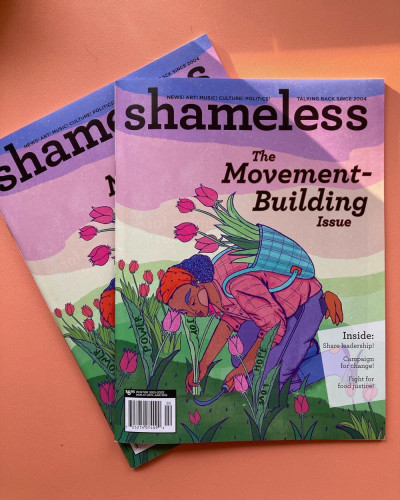
Shameless, Fall 2010

When I joined Team Shameless as art director in 2006, I couldn’t have predicted the impact the magazine would have on my life. Shameless gave me more than an opportunity to flex my design muscles: I became part of an amazing community of inspiring feminists, each with stories to tell and endless energy with which to tell them. That’s just one of the reasons that I was excited to step into my new, additional role as editorial director at Shameless.

Watching our organization grow over the years has been nothing short of amazing, and I’m looking forward to even more exciting projects and experiences ahead.

Since our last issue, we’ve drafted a new mandate, welcomed some new editors to our staff, brought in a new web team (with a site overhaul in the works) and restructured the way we work to better reflect the anti-oppressive values at our core (stay tuned for ways you can get involved). In the midst of this, we also assembled an interim staff of truly shameless women, who, in addition to their roles as board members, writers, educators and editors, took on the extra work of putting together what I think is a fantastic fall issue, currently on the presses. Once you get a hold of it, be sure to check out our masthead and send them a little “thank you” for their dedication, hard work and that endless energy I mentioned earlier.

This coming issue (expected to arrive mid-September) is the first of many that will strive toward our new vision. In it, we bring you a chorus of bicycle bells, the voices of our sisters at AQSAzine and options for life beyond high school. We explore rape culture, the intersection of race and feminism and the etymology of the word “cougar”. And, to tide you over until the winter, we give you the tools you need to surf the web in style, make a mean eggplant lasagna and fly a kite. Be sure to take advantage of our subscription sale before the month’s end, and I hope that you enjoy our fall issue as much as we’ve enjoyed putting it together for you.

Yours shamelessly,
 sheila

Body Politics
Losing weight for college endowments

A British pound is worth about a buck 50, but a Stephens College pound is worth $4,000.

No, really.

A health-conscious alumna from Oregon has agreed to donate $1 million to Stephens if faculty and staff lose a collective 250 pounds by Jan. 1. Oh, and if college President Dianne Lynch personally drops 25 pounds, the donor will give another $100,000.

Coerced weight loss for money? Really?

Manipulative?

Unfair?

Promoting a healthier lifestyle? Why tie it to weight loss and not to activity levels or fruit and veggie consumption, then?

Read the whole story here, and let us know what you think.

H/T to Michelle S.

All About Shameless
12 days of shameless’s summer sale left

Our summer sale ends in 12 days, and if you order your subscription in the next few days, you will be among the first lucky folks to have our brand new fall issue delivered straight to your mailbox, hot off the press!

Until Sept. 1, 2010, subscription are only $12! After Sept. 1 we will be increasing our subscription price so that this volunteer-run, independent media organization can keep up with rising postal rates and other costs.

Order your subscription here. Already have one? How about a back-to-school present for your sister, your best friend, your school library, your neighbour….

Media Savvy
Love the Way You Lie

Eminem’s single “Love the Way You Lie” featuring Rihanna has gotten a lot of attention from the feminist community, most of it negative. The song has been criticized for glorifying and romanticizing an abusive relationship, and Rihanna’s decision to feature in it has been questioned and criticized, considering her recent, very public abuse at the hands of ex-partner Chris Brown. There’s a fear that young women, in particular, will see the song and video as evidence that “true love hurts.” There’s also a victim-blaming narrative going on here, suggesting the woman in the relationship is asking for abuse through her own behaviour.

I’ve also seen another perspective on the song, calling the negative critiques one-dimensional. This argument calls the song a story of a two-way flawed relationship in which both partners lash out at and attack one another and are both to blame. From this angle, Eminem isn’t glorifying abusive relationships, he’s portraying the agony of a supercharged love-hate relationship neither partner can fix, no matter how hard they try.

Video and lyrics below the jump. What do you think?
(more inside…)

Film Fridays, Queeriosities
The Runaways: Teenage Badasses

Starring Dakota Fanning, Kirsten Stewart, Riley Keough. Directed by Floria Sigismondi, 2009.

Ah, the 1970s. Weren’t they great? David Bowie, the groovy threads, all-girl rock bands, second wave feminism… But then again, some second-wavers were pretty racist, and let’s not forget the Lavendar Menace. Actually… when you think about it? Maybe they weren’t all that great.


The Runaways
is based on the true story of the all-girl rock band of the same name, which brought the world Joan Jett and Cherie Currie, back in the “good ol’ days” of the 1970s. In it, we witness some really interesting critiques of the rock scene at the time, which unfortunately aren’t all that outdated. We learn why the brand of “chick” rock the Runaways helped create was so important, but also how dramatically different it was from the Riot Grrl scene in the 90s was; the DIY punk ethic, this is not. All members of the band can actually play their instruments, sure, but lead singer Currie is picked solely based on her looks (or rather, her “look”). A product being packaged.

the runaways film still

The strength of the film is definitely the take on teenage female sexuality, largely because it is unlike anything I’ve ever seen in a Hollywood film before. This is the story about a band of rocker chicks! And we don’t care about boys! We care about Joan, about Cherie, about their badass sexualities. And that’s the thing; none of that reductive boring heteronormative Hollywood shit. SPOILER ALERT! Joan and Cherie’s relationship is portrayed as a simple yet complicated professional partnership with lots of sexual tension… but never is it explicitly addressed or talked about by them, or by their other bandmates. They fuck, and that’s cool. Even in her other sexual adventures, Jett is portrayed as this man/woman-eating badass, whether it be on stage, after a show, or with a bandmate, but! she is never stuck with any kind of label; queer, or bisexual, or even slut… she just is who she is, seduces who she seduces, and we get to admire (or perhaps, aspire) to that level of bravado.

Early on in the film, we are exposed to exactly how hateable the band’s notorious producer Kim Fowley is, as he literally puts words in Cherie’s mouth and attempts to treat the band as his minions rather than as musicians or human beings. In fact, he’s easily the most misogynist character. But that’s what makes the story compelling and complex; the man so driven to create the world’s first major label all-girl rock band, singing lyrics like “I wanna be where the boys are/I wanna fight how the boys fight,” with band members who kick ass and take names, is largely created and managed by this… well, raging sexist douchebag.

However, The Runaways - artistically and story-telling style wise - really sits on the fence as to what genre it falls into. One minute it feels like it wants to be art-house cinema, with vague scene transitions, unexplained scenes and out of focus shots, and the next minute it is toeing the (pretty tired) “rock biopic/period piece” line. The treatment of drug abuse and excess is done beautifully on the visual side, but simultaneously it isn’t gritty enough. It ends up looking strangely glamourous - stranger still given the fact that Currie was 15 when she joined the band and her exposure to drugs and alcohol lead to a life-long battle with addiction.

the runaways film still 2

Dakota Fanning as Cherie Currie in The Runaways (Sigismondi, 2010) (the runaways film still)

That said, even with the stylized drug/alcohol scenes, it isn’t really all that visually stimulating as a movie. Given that it is (Montreal’s own) Sigismondi’s first full-length feature, I suppose those factors aren’t entirely unsurprising. I really do hope that Sigismondi takes up fiction for her next film. I think her craft and style would really shine through in a more free or even fantastic setting.

But, overall, there is more good than bad to be said of the Runaways. Fanning and Stewart deliver stellar performances and make for a captivating and empowering movie about young women who try to live their lives looking for adventure and striking a balance between fantasy and reality. Given the fact that these two young actresses are better known for their (pretty bland, pretty anti-feminist) characters in the Twilight franchise, I think audiences of all ages and tastes can give these two actresses a lot of credit for trying out these two rock icons for size.

While it could be interpreted as feminist thanks to the strong female leads, it still holds an interest for mainstream audiences and doesn’t hit you over the head with the “omg the rock scene was so sexist in the 70s! and now it’s perfect!” Instead, it makes you feel even more excited for the band when they make it, and the fact that everyone can sing along to a Joan Jett song, the person who was told that “girls don’t play electric guitars” back in 1977, and all the more exciting. The real power of the film lies with the true events that inspired it, and it does so without exploiting real people’s lives. It’s exciting to think that fans of Twilight might watch this film just because Stewart is in it, and will end up discovering an important part of women in rock history, and hey, might even be inspired to pick up an instrument. Now that would be really badass.

3.5/5 stars

Further reading:
B-Sides: Suzi Quatro

Cherie Currie’s interview on Q

The Runaways official website

Miscellaneous
Women as Leaders in Education

Are you a leader in your school? Or have you taken your leadership skills back to your school or other community schools? Jennifer Martin works at a public alternative school in Michigan and is conducting research on feminism and leadership in public schools and needs your help!

What’s even cooler is that she’s set up the research on her blog: http://womenasleadersineducation2010.blogspot.com/

To submit your feedback and contribute to her project and thus forwarding the field of feminist public education just check out her message below. She’s even throwing in an iPod as a prize to one lucky winning contributor!

Study information:

I am conducting a qualitative study on women leaders in education for the purpose of gaining insight into women’s unique experiences as educators (in K-12 and higher education). I am looking for women who work as leaders in education—either in higher education or in PK-12 education (and adult education). “Leaders in education” can mean formal leadership: administrators, deans, principals, department heads, or informal leaders (those who work within their systems for social change, for example).

I have created a web blog where participants can respond to a variety of questions. Participants will also be able to engage with one another in an online dialogue about a variety of issues women in education face.

I ask that participants create an account in Google blogger using information that will protect their anonymity (for instance, do not use your name as your username). Participants may respond to any or all of the questions listed. I have created separate posts for each individual question (which are listed below). You can respond to questions by clicking on their links either on the blog home page, or on the menu on the right. Participants are not required to answer all questions, and can return to the site, answer additional questions, and repost. Participants can choose whether or not to interact with others in online dialogues.

After making your decision to participate, please email me at jlmarti2@oakland.edu. I will then email you a consent form for you to sign which will indicate your agreement to participate in this study. After signing, please scan the document, or create a PDF, and email it back to me at the same email address. If you do not have access to these technologies, you may mail the consent form to me. Postage will be provided. I will provide you with the information for mailing upon your email contact.

As an incentive to gain participants in this study, I will conduct a drawing for an 8 GB iPod Nano based upon posted responses. Drawing will be done on December 31, 2010.

Miscellaneous
Call for submissions for book: Deconstructing the academic industrial complex of feminism

Check out this call for submissions for a book the wonderful Jessica Yee is putting together! If you’ve ever gone to “university” or “post-secondary education” or didn’t go but had your own brush with it and have something to say check this out! The deadline is September 10th, 2010 so time is short. But, in my experience passionate tales of feministy academy often ramble off our tongues.


Call for submissions for book: Deconstructing the academic industrial complex of feminism - Feminist education now: youth, activism, and intersectionality
(working title – tentatively to be changed) edited by Jessica Yee

To be published by the Canadian Centre for Policy Alternatives – Winter 2011

Why the new title? Because I was getting A LOT of “I just want my name to be published” submissions that weren’t really dealing with the question of where is feminist education today? So I decided to be more in your face and say that this is about “deconstructing the academic industrial complex of feminism” meaning this is about where feminism exists OUTSIDE the university/school walls - or why so much of the so-called “recognizable” feminism is just within academia.

Where is feminist education today? This is a question many people are asking, and I’d like to answer them in a book I’m putting together. Where do young people get to learn about feminism? And what the heck does feminism even mean to young people today? (and I’m talking about young, young people, not you 3rd year women’s studies person who might roll your eyes at my next set of questions. Maybe think of yourself before you got into women’s studies. Or if you ARE/WERE in women’s studies and think it’s kinda messed up, I’d like to hear about that too.) How come as a “theory” we don’t really hear about it unless we get to go to post-secondary type schooling, but in practice lots of us have been feminists of sorts throughout our entire lives. Why does it still look like a white-woman’s thing? Or not entirely sex-positive? What do young men have to say about it? Has there really been any intergenerational information sharing between those who might have “paved the way” and those who are thinking about identifying as feminists now?

With the working title of “Feminist education now: youth, activism, and intersectionality” I’d like to talk about all these issues and everything in between. Don’t like the word feminism? Please be my guest and talk about that – or if it helps to use words like “womanist” or “humanist” instead, or working for women’s rights, women’s empowerment, girls stuff, etc. then go that direction. I’m really interested in talking about the intersectionality of feminist education and breaking down the barriers of what constitutes “education”, where that might be, and according to whom. Education does not have to solely be within a school or school-type setting – if it happened on the street, in your kitchen, if it’s not happening at all, if you want it to happen some particular place – I want to hear about it.

What do I mean by feminism? No I don’t mean that it’s just about women, I mean all identities/definitions/euphemisms/pseudonyms than the English language of the colonizer can do justice to. Expand your mind.

What do I mean by intersectionality? Think of a street intersection and put yourself in the middle. There are lots of things that intersect the way people identify – for example I identify as a woman, as Indigenous, as bisexual, as multiracial and all of those things and way more come into play when I think about the way I want to learn things, i.e. feminist education. For me, I don’t exist as just one thing or another. In this book - I’d like to know about how feminism intersects (or doesn’t intersect) who you are.

Why is the word activism in the title? Because I think a lot of us are activists and even feminists and do education about the things we believe in without necessarily being sign-waving, chanting, picket-lining groups en-masse. I’ve often said some of the best activists I know are the ones who do it at home, wherever “home” might be – since that can sometimes be the hardest place to be passionate and true to the things you are fighting for.

What are we looking for in this book? Written, artistic, and otherwise creative submissions between 700 to 3000 words length if it’s an article. You are also very welcome to submit a photograph, an art piece, a poem, spoken word, etc. as well.

Can only “youth” submit something?
Yes and no – preference will be given to young people under the age of 30 to be published in this book, however if you are over the age of 30 and would really like to say something – please submit and we’ll try and find a place for it, especially if you talk about young people in your piece.

Why would I want to write/create something for this book? Some folks like to have their name and stuff published, others just want their voices and ideas out there. You decide!

When do we want submissions by?
Submission deadline is Friday September 10 2010.

What if I don’t really understand what you are asking for or want help putting something together?
Please feel free to get in touch with me and let’s chat! E-mail me directly at jessica.j.yee@gmail.com

All written, artistic, and creative submissions should be e-mailed with a Word doc. attachment and a 3 line author bio to Jessica Yee at jessica.j.yee@gmail.com no later than Friday September 10th 2010. If you would like to mail yours to a physical address instead, please let me know.

All About Shameless
Shameless summer sale!

Shameless is having a summer sale!

From now until Sept. 1, 2010, you can buy a subscription for only $12! Back issues for only $5! After Sept. 1 we will be increasing our subscription price so that this volunteer-run, independent media organization can keep up with rising postal rates and other costs.

Order soon, as our brand new fall issue will be mailed in a few weeks.

All About Shameless, Film Fridays
well hello shameless!

Hi! I’m julia caron. I’m a 24 year old queer person living in Québec City. In my years, I’ve worked as a newspaper editor, factory worker, used bookstore clerk, and film society director, to name a few. More recently, I’ve been blogging about fashion from a critical feminist perspective at my blog, a l’allure garconnière, since 2009. I’m really excited to join the ranks of Shameless, as I’ve been a reader for years and am excited to shake things up.

Here at Shameless, I’ll be taking care of Film Fridays on a bi-monthly basis. Seeing as one of my favourite hobbies is snuggling up on the couch with my best friends and a big bowl of popcorn and watching our favourite movies, I think the shoe will fit quite nicely.

I gotta say, this will be an interesting ride for me. I recently realized that most of my favourite films hardly pass the Bedchel test, and I am often drawn to men’s stories. I’ve been wondering how my (relatively radical) politics are reflected in my love of movies and my tense relationship with Hollywood. Which movies appeal to me, and why? What makes a film feminist, or even at the more basic level, what kind of movies do we want to see and make as feminists? I’m really excited to start conversations about films with you here at Shameless, to find where we agree and disagree, and what we want and need from the world of film.

So you can get to know me better, here are a handful of my favourite films in no particular order, some of which you can watch online by clicking the links:
XXY (Puento, 2007)
Pandora’s Box (Pabst, 1929)
Alphaville (Godard, 1965)
La Jetée (Marker, 1968)
The Royal Tenenbaums (Anderson, 2001)
Meshes of the Afternoon (Derren, 1943)
Kanehsatake: 270 years of resistance (Obomsawin, 1994)
le chat dans le sac (Groulx, 1965)
Modern Times (Chaplin, 1936)

But! if you haven’t seen (or even heard of) many of these films, have no fear! I’m going to try to focus on current movies, ones that are just released for rental or are still in the movie theatres, with a Retro Film Friday thrown in from time to time for good measure. And I want to know what you are watching, too. If you have any requests of films you’d like to see reviewed, send me an email! juliacaron AT gmail DOT com.